What Are the Most Important Details in WPC Decking Installation?
A reliable WPC decking system starts with a stable substructure and good drainage. Joist spacing must suit the decking profile, board ends need adequate support, expansion gaps must allow for normal dimensional movement, and fasteners must be compatible with the selected board system.
1. Plan Proper Drainage Before Installing WPC Decking
•Why? Standing water is one of the most common causes of deck discoloration, mold growth, and accelerated aging. During joist installation, create a drainage slope of approximately 1%–2%, or 1–2 cm per meter, toward the drainage direction.
•How?
How to Set the Slope
✓ Identify the highest and lowest drainage points before installing joists.
✓ Use a string line or laser level to guide the slope.
✓ Keep the slope consistent across the full deck area.
How to Verify Drainage
✓ Perform a water test after installation.
✓ Check whether water flows smoothly away from the deck.
✓ Correct any low spots before finishing the edges.
2. Match Joist Spacing to the WPC Decking Profile
•Why? The joists are the “framework” of the decking. If the spacing is too wide, the deck will sag, make noise, and warp.
•How?
o General Specifications: The center to center spacing of joists for most WPC decking should be ≤ 30cm (300mm).
o Advanced Options:
Decking thickness ≥ 25mm and high density:
The spacing can be widened to 35cm (confirm load-bearing capacity with the manufacturer).
Decking thickness < 20mm or special areas like balconies:
Strongly recommend reducing to 25cm.
Cantilevered Sections (e.g., deck edges):
Further reduce joist spacing or add additional support.
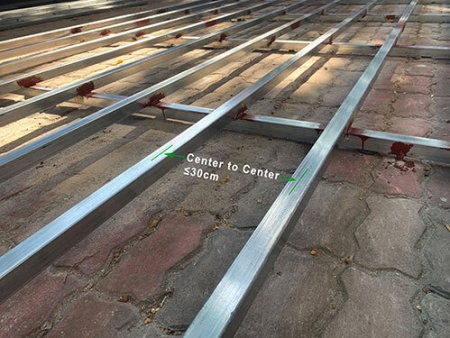
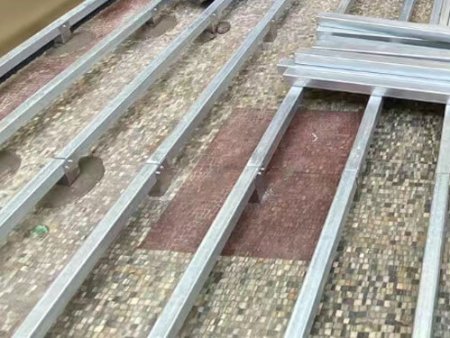
 Material Recommendation: Aluminum or stainless-steel joists are preferred for outdoor projects because they offer better corrosion resistance and long-term dimensional stability.
3. Support WPC Decking Board End Joints Correctly
•Why? Improper end-joint handling during WPC decking installation can lead to shrinkage, detachment, and other issues.
•How?
o Independent Support: Ensure each decking board end is independently supported by a joist. Never allow two board ends to share a single joist.
o Double Joist Structure: Use a double-joist structure at end joints and secure with separate clips.
o Avoid Stress Concentration: All fasteners should be installed on independent joists to avoid stress concentration.
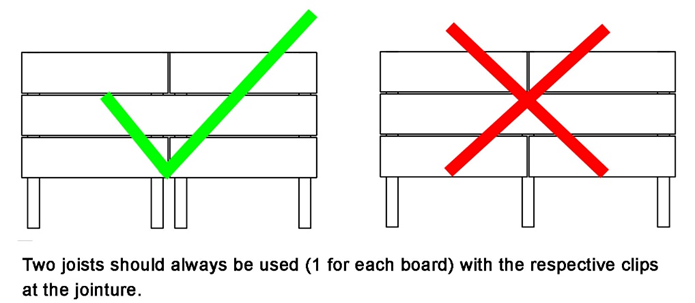
Best Practice: Each board end should have its own support and fastening position. This helps reduce stress concentration and improves long-term joint stability.
4. Leave Appropriate Expansion Gaps Between WPC Decking Boards
•Why? WPC expands and contracts with temperature changes! Insufficient gaps during WPC decking installation can cause buckling, deformation, and even cracking or edge bursting when the decking expands.
•How?
| Gap Position | Recommended Gap |
|---|---|
| Around walls or fixed objects | 8–12 mm |
| Between board ends | 3–5 mm |
| Between board sides | 5–8 mm, depending on the clip system |
| Between large-area sections | 5–8 mm or adjusted according to climate conditions |
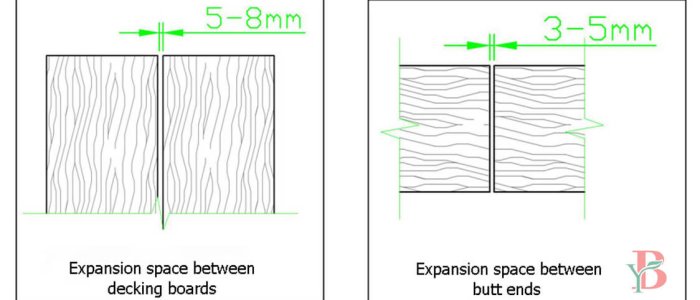
Pro Tip: Unpack WPC decking boards and allow them to acclimate to the installation environment for about 48 hours before installation.
5. Manage Long Decking Runs with Breaker Boards
•Why? WPC is affected by temperature and humidity changes, causing thermal expansion and contraction. Large continuous installations can lead to stress buildup, causing overall warping, corner lifting, uneven expansion gaps, or local deformation. Proper WPC decking installation use segmented installation to divide large areas into smaller sections, releasing stress and enhancing stability and durability.
•How?
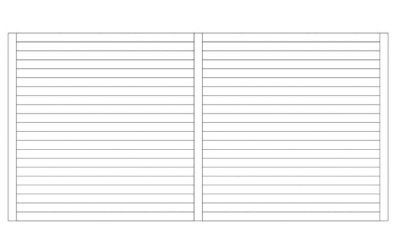
o Divide the Installation Area: Limit each section to ≤ 6 meters (adjust based on local climate and temperature variations; shorter segments for greater differences).
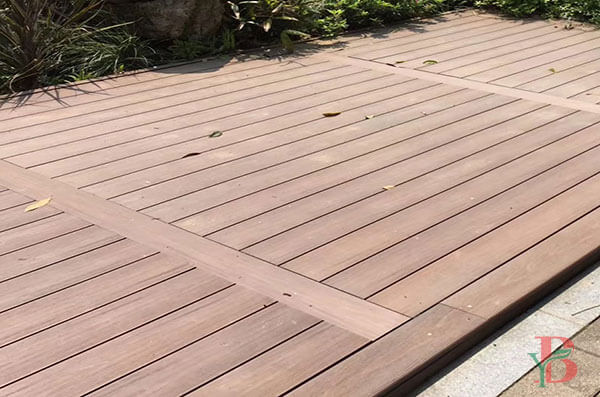
o Use Breaker Boards as Dividers: Split large areas into smaller independent sections.
o Set Expansion Gaps: Leave 5-8mm expansion gaps between sections (on both sides of the breaker board). Increase gap width if installing in extreme temperatures (e.g., midsummer or midwinter).
o Reinforce Structural Support: Add extra transverse support under breaker boards to ensure stability. Ensure each section’s ends are firmly supported by joists.
o Optimize Drainage: Each segmented area should have its own drainage slope to prevent water accumulation at expansion gaps.
For more details, read our guide to breaker boards for composite deck installation.
6. Choose the Right Fastening System for WPC Decking
•Why? WPC decking clips or screws ensure stability and facilitate easy replacement.
•How?
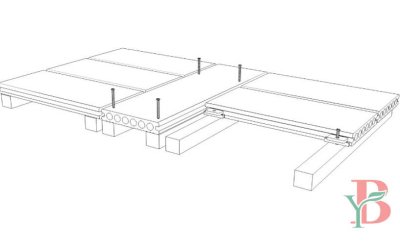
Hidden Clip System
✓ Creates a nail-free deck surface.
✓ Helps maintain consistent side gaps.
✓ Supports easier single-board replacement.
✓ Suitable for grooved WPC decking profiles.
Face-Fixing with Screws
✓ Use stainless-steel countersunk self-drilling screws.
✓ Pre-drill holes to reduce cracking risk.
✓ Use mainly for edge boards, stairs, or special structural areas.
✓ Avoid over-tightening screws into WPC boards.
Learn more about the difference between face screws and hidden fasteners for composite decking.
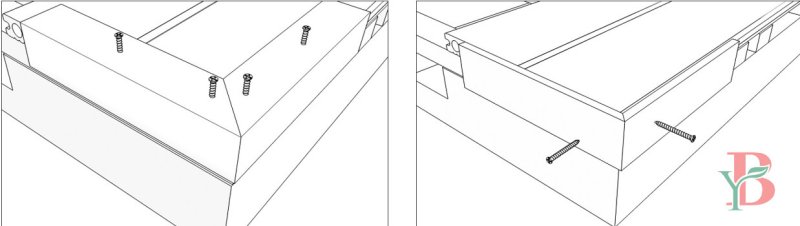
7. Plan WPC Decking Edge and Fascia Details
•Why? Edges are the most vulnerable parts of and WPC decking installation. Poor finishing affects aesthetics and can lead to lifting, cracking, dirt accumulation, and tripping hazards. Careful edge treatment enhances installation quality, extends lifespan, and ensures long-term beauty and safety.
•How?
o Use L-shaped Edge Trim: Select L-shaped WPC or aluminum edge trim, securely fixed with screws at approximately 500mm intervals.
o Use Straight Board Edge Cover: Fixed the straight board edge cover with screws from the side at approximately 500mm intervals.
o Cut Same Decking for Edge Cover: Vertically cut the same decking material to form an L-shaped edge and then fix it.
o Stair Edges: Use specially designed WPC staircase boards.
8. Inspect and Maintain WPC Decking After Installation
•Why? Correct installation is only the first step. Simple maintenance after installation helps keep WPC decking clean, safe, and stable for long-term outdoor use.
•How?
Cleaning
✓ Sweep away dust, leaves, and debris regularly.
✓ Clean stains with neutral cleaner and a soft brush.
✓ Avoid strong acidic or alkaline cleaners.
✓ Do not use steel wool or sharp cleaning tools.
Inspection
✓ Sweep away dust, leaves, and debris regularly.
✓ Clean stains with neutral cleaner and a soft brush.
✓ Avoid strong acidic or alkaline cleaners.
✓ Do not use steel wool or sharp cleaning tools.
For a full care plan, read our composite decking maintenance guide.
Common WPC Decking Installation Mistakes to Avoid
Many WPC decking problems are related to small installation mistakes. Avoid the following issues to improve long-term stability and appearance.
Installing WPC decking directly on soil, grass, or unstable ground.
Ignoring drainage slope and allowing water to collect under the deck.
Using joist spacing that is too wide for the board profile.
Failing to leave proper expansion gaps near walls and board ends.
Allowing two board ends to share one joist without independent support.
Using ordinary screws that are not suitable for outdoor WPC decking.
Over-tightening fasteners and restricting natural board movement.
Sealing deck edges completely and blocking airflow.
Frequently Asked Questions About WPC Decking Installation
What joist spacing is recommended for WPC decking?
Around 300 mm center-to-center is commonly used as a reference for many conventional WPC decking boards, but the correct spacing depends on board thickness, profile structure, expected loading and the manufacturer’s specification.
How much expansion gap should I leave for WPC decking?
The required gap varies with board length, profile, installation temperature and fastening system.
As a general guide, leave 8–12 mm around walls or fixed objects, 3–5 mm between board ends, and 5–8 mm between board sides depending on the clip system. Adjust the gap according to local climate and installation temperature.
Can WPC decking be installed directly on soil or grass?
WPC decking should normally be installed on a stable, appropriately supported substructure rather than directly on unstable soil or grass. The construction must also provide suitable drainage and ventilation.
Should WPC decking board ends use double joists?
Where two board ends meet, sufficient support and fastening space must be provided for both boards. Depending on the framing design, this may require double joists or additional blocking.
Are hidden fasteners better for WPC decking?
Hidden clips are preferred for most grooved WPC decking boards because they create a clean surface, control board spacing, and allow natural expansion and contraction. Stainless-steel screws may still be used for edge boards, stairs, or special structural areas.
Do large composite decks need breaker boards?
Not every deck requires a breaker board, but they can be useful for long board runs, larger deck areas and layouts where a clean transition between decking sections is needed.
Do I need special professional tools to install WPC decking?
No special heavy machinery is required. You can install WPC decking using standard woodworking tools, such as a miter saw (with a fine-tooth carbide-tipped blade), a power drill, a tape measure, and a level. For a professional, seamless finish, we highly recommend using a hidden fastener system, which automatically manages the spacing between boards and leaves no visible screw heads.
How do I make WPC deck edges look professional?
Use L-shaped edge trim, fascia boards, straight board covers, or dedicated stair boards. Make sure edge details are firmly fixed while still allowing ventilation and expansion gaps.
Recommended WPC Decking Products and Related Guides
Choose the right WPC decking profile and installation accessories before starting your project. The following pages may help you compare options and plan a more durable deck system.