Understanding WPC board fire resistance is essential for builders, architects, and homeowners. WPC (Wood Plastic Composite) boards are made by combing wood fibers with plastics, offering improved fire resistance compared to natural wood. While not completely fireproof, WPC boards meet fire safety requirements when manufactured and installed properly. This guide explains WPC fire ratings, compares WPC with traditional materials, and explores methods to enhance fire safety for decking, siding, and other applications.
🔥 Fire Performance: WPC vs. Traditional Wood
When evaluating building materials, the comparison between WPC board fire resistance and traditional timber is crucial for safety compliance. Studies and industry experience show:
- Ignitability: WPC boards show good results in ignitability tests, performing similarly to natural wood of a comparable density.
- Flame Spread: In “spread of flame” testing, WPC often outperforms traditional timber. The plastic matrix (such as PVC-U or HDPE) acts as a barrier that improves the fire performance of the wood component.
- Overall Behavior: General industry experience shows that WPCs exhibit fire behavior that is equal to, or often superior to, that of comparable timber products.
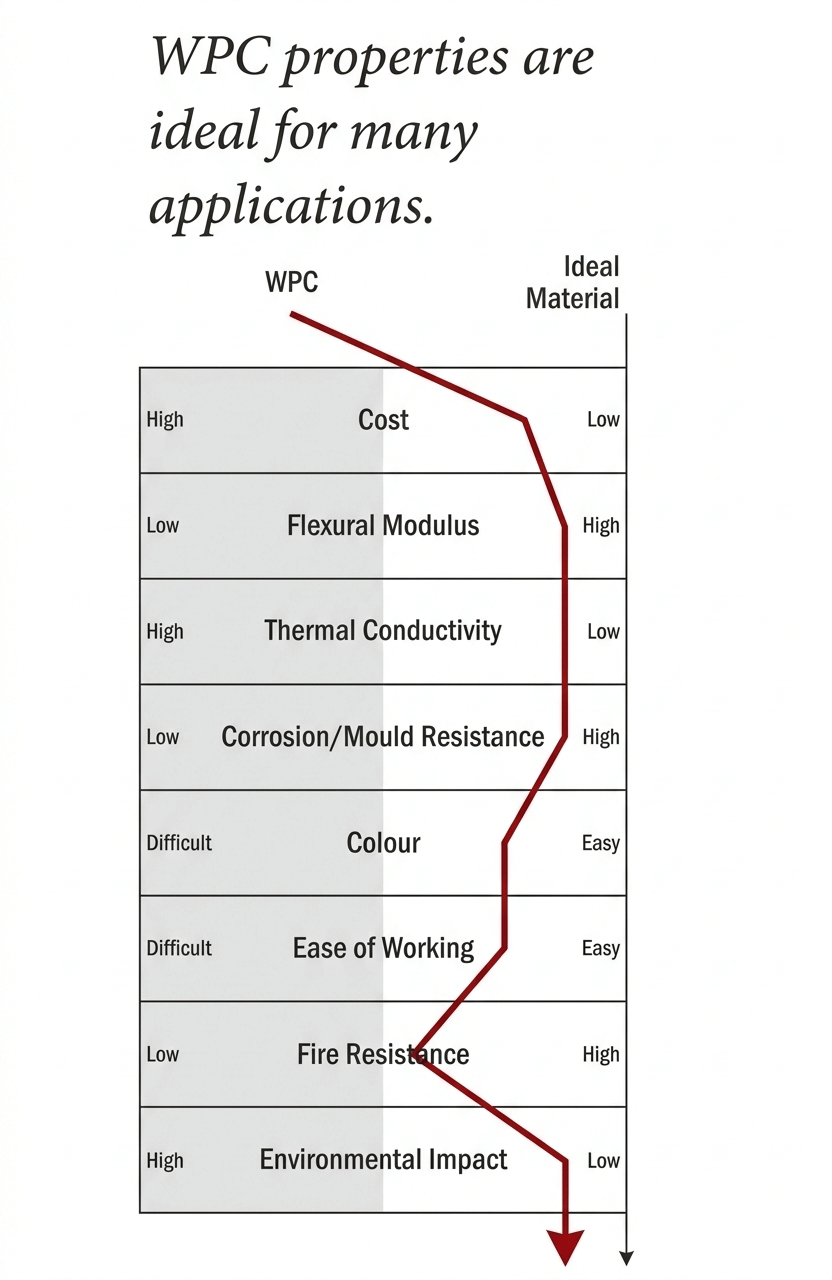
*Index values indicate relative performance of typical high‑grade WPC; actual figures vary by formulation.
🧪 Understanding WPC Fire Rating Classifications
International standards help classify the fire resistance of building materials, including WPC:
| Standard | Description | Reference | |
| ASTM E84 | Measures flame spread and smoke development (USA standard) | ASTM E84 Official | |
| EN 13501-1 | European fire classification (A1 to F) | EN 13501-1 Details | |
| GB 8624 | Chinese fire classification for building materials | GB 8624 Standard |
Understanding WPC fire ratings (Class A, B, and C) is essential for choosing the right material for commercial or residential projects. These ratings are determined by standards such as ASTM E84 and EN 13501-1:
- Class A Rating: WPC boards typically do not achieve a Class A fire rating, which indicates the highest level of fire resistance. Most WPC products are more commonly classified as Class B or Class C. Select WPC manufacturers offer specialized fire-proof formula products that can achieve a Class A rating under the ASTM E84-018 standard, highlighting the potential to deliver enhanced fire-resistance properties.
- Class B and C Ratings: Many WPC boards are categorized as Class B or Class C under various testing standards such as EN 13501-1 and ASTM E84. Class B indicates significant fire resistance suitable for commercial applications, while Class C provides moderate resistance appropriate for standard uses.
📋 What Determines WPC Board Fire Resistance?
The fire performance of WPC boards depends on multiple factors:
- The ratio of wood fibers to plastics in the composite
- Use of flame retardant additives during production
- Manufacturing techniques such as co-extrusion or surface coatings
📋 How to Enhance WPC Board Fire Resistance?
To achieve high fire-rated WPC status, manufacturers incorporate specialized additives during the production process:
- Maintaining optimal wood/plastic ratios for improved fire performance
- Adding flame retardant chemicals during production
- Using fire-resistant surface coatings or co-extrusion layers
For more practical tips, see our WPC installation guide to ensure safety and durability.
WPC Board Fire Resistance Test
⚖️ The Engineering Challenge: Balancing Fire Retardancy and Structural Integrity
While fire safety is a top priority, it is important to understand the technical reality of WPC manufacturing. Most standard WPC boards are not naturally fireproof. Achieving a high-grade WPC board fire resistance (such as Class B or Class A) requires the addition of high concentrations of flame retardants (e.g., Magnesium Hydroxide or Ammonium Polyphosphate).
-
The Trade-off: Flexural Strength vs. WPC Board Fire Resistance
Adding large amounts of inorganic flame retardant fillers can often impact the mechanical properties of the board:
- Reduced Flexural Strength: High mineral filler content can make the composite more brittle, potentially lowering the Modulus of Rupture (MOR).
- Impact Resistance: Increased fire retardancy can sometimes lead to a decrease in the board’s ability to absorb sudden impacts without cracking.
- Density & Weight: Fire-rated additives often increase the overall density of the board, which must be accounted for in structural framing and installation.
The Modern Solution: Co-extrusion Technology
To solve the conflict between safety and durability, we utilize Advanced Co-extrusion (Capped WPC) to maximize WPC board fire resistance. This dual-layer approach ensures the core remains strong while the outer shell provides superior protection:
- The High-Strength Core: Engineered for maximum flexural modulus and load-bearing capacity using optimized wood-fiber-to-polymer ratios.
- The Fire-Resistant Shield: A specialized outer “cap” or shell infused with concentrated flame retardants and UV stabilizers.
✔ This ensures the board achieves a superior fire rating without compromising the structural durability or longevity required for heavy-duty commercial decking and cladding.
⚠️ Safety Limitations and Best Practices for Construction
While WPC offers enhanced protection, it is vital to acknowledge its limitations to ensure maximum site safety.
Heat Sensitivity
No building material is 100% fireproof; even Class A rated WPC can ignite if exposed to a high enough heat source for an extended period.
Duration of Resistance
The primary advantage of a higher fire rating is that the material will resist ignition for a much longer period than lower-rated alternatives, providing critical time for emergency response.
Implementation
It is imperative to implement appropriate fire safety measures and consult local building codes whenever employing WPCs in construction projects.
❓ FAQs About WPC Board Fire Resistance
Is WPC board fire resistant?
No, WPC is fire-resistant but not 100% fireproof. While the wood fibers are combustible, high-quality WPC boards are treated with flame retardants to achieve Class B or even Class A fire ratings under standards like ASTM E84, significantly slowing the spread of flames compared to natural wood.
Does WPC board fire resistance degrade over time?
Fire resistance may reduce if exposed to extreme UV, moisture, or poor installation. Choose high-quality boards with proper certifications for long-term safety.
Can WPC boards achieve Class A fire rating?
Yes. With appropriate additives and manufacturing methods, WPC boards can achieve ASTM E84 Class A or equivalent ratings.
What is the typical fire rating for WPC?
Most standard WPC boards are Class B or C. Specialized “fire-rated” WPC can achieve Class A (FSI ≤ 25) through advanced additives.
How can I verify a WPC board's fire rating?
Check manufacturer specifications for ASTM E84, EN 13501-1, or GB 8624 certification and request lab test reports when necessary.
📌 Conclusion: Balancing Safety and Performance
Understanding WPC board fire resistance goes beyond a “fireproof” label. Adding high amounts of inorganic flame retardants can reduce flexural strength and impact resistance. The solution is Advanced Co‑extrusion (Capped WPC) — a high‑strength core paired with a fire‑resistant shield. This dual‑layer approach delivers superior WPC fire rating without compromising the structural integrity required for heavy‑duty decking and cladding.
For detailed insights and deeper understanding, refer to the following sources:
- NewTech WPC: WPCs and Fire
- SafetyLit: WPCs Fire Protection Kit
- U.S. Forest Service: Research on WPCs
✉️ Action: Secure Your Project
Don’t compromise on safety or strength. Choose certified WPC board fire resistance for your next project.
- Get Data: Request ASTM E84 test reports.
- Get Samples: Order a fire-rated Capped WPC sample.
- Get Expert Advice: Contact us for a free safety consultation.