
In the world of outdoor construction, finding a material that balances natural beauty with rugged durability used to be a challenge. Enter WPC material (Wood Plastic Composite—an innovative material that blends the timeless look of wood with the high-performance resilience of plastic.
This composite material is gaining popularity in various industries due to its unique properties and environmental benefits. Whether you are a homeowner planning a new deck or a contractor looking for sustainable building solutions, this guide covers everything you need to know about WPC.
What Is WPC Material?
WPC material is a family of composite materials that combine lignocellulosic fibers—usually wood flour, wood fibers, bamboo dust, rice husk, or similar plant-based material—with a thermoplastic polymer. The ingredients are mixed under controlled conditions and formed into boards, profiles, panels, or components.
The purpose of combining wood and plastic is not simply to imitate natural timber. The composite structure allows manufacturers to balance appearance, moisture resistance, dimensional behavior, strength, surface texture, processing efficiency, and cost for a specific product application.
WPC should not be treated as one universal material. A hollow polyethylene-based decking board, a solid PVC-based trim profile, and a capped composite wall panel may all be described as WPC, but their formulations, structures, test results, installation requirements, and suitable uses can be very different.
What Is WPC Made Of?
A typical wood plastic composite contains three broad ingredient groups. The exact percentages vary by manufacturer, product series, production method, and performance target.
Wood or Plant Fiber
Wood flour and other natural fibers contribute stiffness, texture, appearance, and bulk. Fiber particle size, moisture content, species, treatment, and consistency can influence extrusion quality and long-term performance.
Thermoplastic Polymer
Common matrix materials include high-density polyethylene (HDPE), polypropylene (PP), and polyvinyl chloride (PVC). The polymer binds the fiber and affects water resistance, impact behavior, processing temperature, and dimensional movement.
Performance Additives
Formulations may use coupling agents, lubricants, pigments, UV stabilizers, processing aids, fillers, antioxidants, and other modifiers. Their selection should match the product’s intended climate and use.
Manufacturer insight: Two boards with a similar appearance can perform differently because formulation control, raw-material cleanliness, fiber drying, dispersion, extrusion temperature, cooling, cap-layer quality, and quality inspection all matter.
Material Composition of Bongywood WPC Material
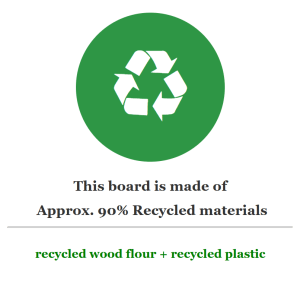
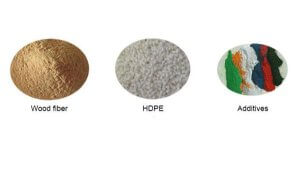
The basic composition of Bongywood WPC is centered on sustainability, utilizing recycled wood fibers and recycled HDPE. This can be represented as:
How Is WPC Material Manufactured?
Most outdoor WPC material profiles are manufactured by extrusion. A controlled WPC manufacturing process is necessary because natural fibers contain moisture and respond differently to heat than thermoplastic polymers.
Raw-Material Preparation
Wood fiber is screened and dried. Polymer, pigments, and additives are selected and checked before mixing.
Mixing and Pelletizing
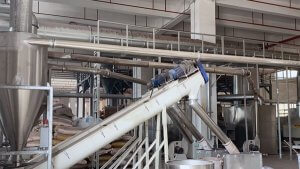
Wood fiber, polymer, pigments, and additives are thoroughly mixed and pelletized into uniform WPC granules for stable extrusion.
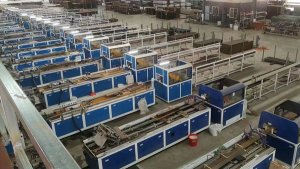
Extrusion
The WPC granules are heated, melted, and forced through an extrusion die that determines the final profile shape, such as a hollow decking board or cladding panel.
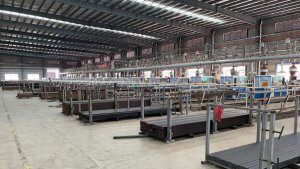
Shaping and Cooling
The extruded profiles pass through a calibration and cooling tank, where they are shaped and cooled to maintain accurate dimensions and straightness.
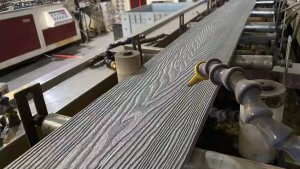
Surface Finishing
The board may be brushed, sanded, embossed, deep embossed, or co-extruded with a protective cap layer.
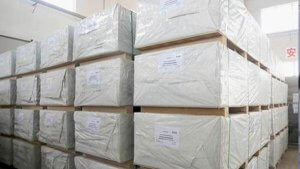
Inspection and Packing
Dimensions, appearance, color, weight, surface quality, and other product-specific characteristics are checked before packing.
Capped composite products add a co-extrusion stage in which a protective polymer layer is formed around part or all of the WPC core. Learn more about four-sided capped composite decking.
Main Types of WPC Material
WPC can be classified by polymer type, surface construction, profile structure, and intended application. Understanding these categories helps buyers compare products more accurately.
WPC Types by Polymer
| WPC type | Typical characteristics | Common applications |
|---|---|---|
| PE-based WPC | Commonly used in outdoor profiles because of its good processability, moisture resistance, and impact performance. Many formulations use recycled HDPE as the polymer matrix. PE-based systems generally offer good outdoor durability, although their relatively high thermal expansion should be considered during installation. | Decking, fencing, exterior cladding, railings, pergolas, and landscape products. |
| PP-based WPC | Can provide higher stiffness, strength, and heat resistance than many PE-based systems. Its final performance depends on the formulation, wood-fiber content, and product design. PP-based WPC is often selected when greater structural rigidity or higher service-temperature resistance is required. | Automotive components, technical profiles, furniture components, pallets, and selected building products. |
| PVC-based WPC | Offers good stiffness, dimensional stability, surface finish, and inherent flame resistance. However, PVC has a relatively narrow processing-temperature window and requires effective heat and UV stabilization. Its processing stability is more demanding than that of PE or PP systems, while the finished product can still provide good dimensional stability when properly formulated. | Interior and exterior trim, door and window frames, wall panels, boards, decorative profiles, and other rigid building products. |
Uncapped vs Capped WPC
Uncapped WPC
In uncapped products, the composite core forms the exposed surface. These products are usually more economical but can be more dependent on formulation quality, pigmentation, cleaning, and moisture management.
Capped or Co-Extruded WPC
A protective polymer layer covers the core. A well-designed cap can improve resistance to staining, fading, scratching, and surface moisture while providing more complex colors and grain patterns.
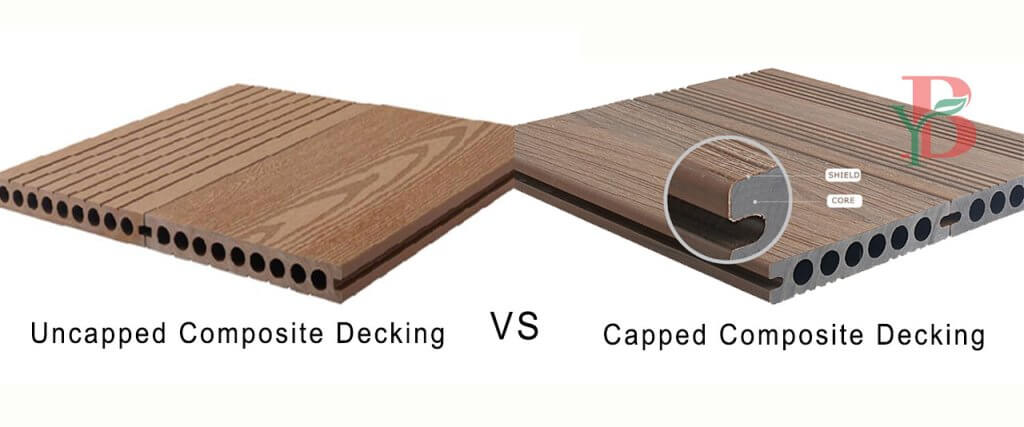
Hollow vs Solid WPC Profiles
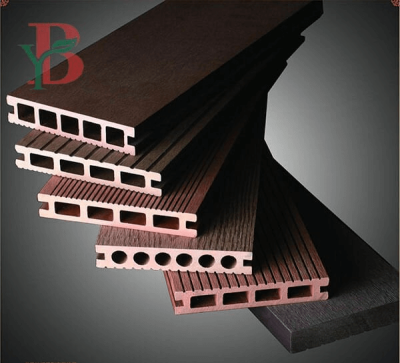
Hollow profiles can reduce weight and material use, while solid profiles may be preferred for certain high-traffic, edge-detail, or machining requirements. Neither structure is automatically superior: wall thickness, internal rib design, density, span, installation, and test results determine suitability.
Six Advantages of WPC Material
Why is WPC rapidly replacing pressure-treated wood? Here are the top five reasons:
High Durability & Weather Resistance
Unlike natural wood, WPC does not absorb water easily. This prevents the common "wood trio of doom": rotting, warping, and splitting.
Low Maintenance Requirements
Forget the annual ritual of sanding or staining. WPC requires no chemical treatments. A simple wash with soap and water is enough.
Aesthetic Versatility & Style
Modern WPC offers 3D Embossed grains. From "Charcoal Gray" to warm "Teak," it provides consistent, premium color and texture.
Eco-Friendly & Sustainable
Bongywood WPC is made from 90% recycled materials. Choosing WPC helps reduce landfill waste and preserves our forests.
Enhanced Safety
WPC is splinter-free and engineered with anti-slip textures, making it a priority for families with children or pets.
Fast & Easy Installation
Designed with hidden clip systems, WPC allows for faster installation than traditional timber, saving time and labor costs.
For long-term performance, read our WPC decking installation guide and composite decking maintenance guide.
Disadvantages and Limitations of WPC Material
A credible WPC guide should explain both benefits and limitations. The following points do not mean WPC is a poor material; they show why product selection and installation must match the project.
Where WPC Performs Well
- Outdoor surfaces requiring lower routine maintenance
- Projects needing consistent color and profile dimensions
- Humid or insect-prone environments
- Residential and commercial landscape applications
- Projects using a tested, complete installation system
Factors Buyers Must Manage
- Higher initial cost than some untreated wood options
- Heat build-up in strong sunlight, especially with dark colors
- Thermal expansion and contraction
- Possible fading, staining, scratching, or mold on surface debris
- Quality differences between manufacturers and product grades
WPC Can Become Hot in Direct Sun
Like timber, PVC, stone, and other outdoor surfaces, WPC can heat up under strong sunlight. Surface temperature depends on color, solar exposure, board structure, airflow, ambient conditions, and formulation. Lighter colors are usually preferable for very hot, sunny sites.
WPC Expands and Contracts
Thermoplastic components respond to temperature changes. Installers must follow the specified end gaps, side gaps, joist spacing, ventilation requirements, fixing method, and breaker-board layout. Ignoring thermal movement can contribute to buckling, uneven joints, or fastener stress.
Not Every WPC Profile Is a Structural Beam
Some WPC products are engineered and tested for structural or code-recognized uses, but ordinary decking, cladding, and decorative profiles should not automatically be treated as primary load-bearing beams. Use the manufacturer’s span table and applicable local code requirements.
Common Applications of WPC Material
WPC can be extruded into a wide range of outdoor profiles. The correct product depends on loading, exposure, fire requirements, slip requirements, fastening, and local regulations.
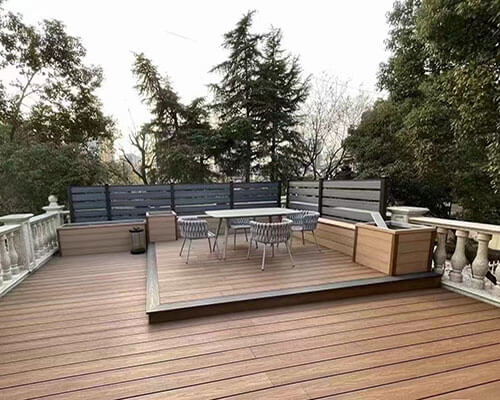
Composite decking is used for gardens, balconies, terraces, walkways, resorts, commercial spaces, and pool surrounds. Product selection should consider span, slip data, drainage, board temperature, and traffic level.
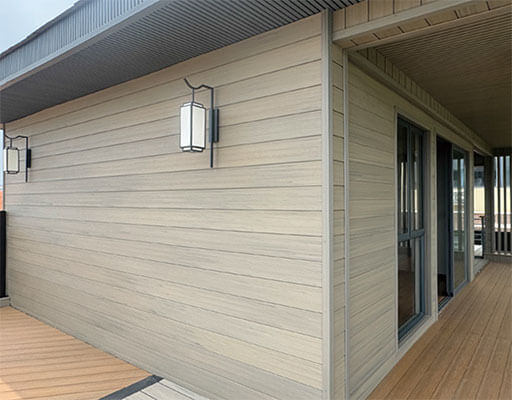
Exterior WPC wall panels provide a wood-like façade with consistent profile geometry. The wall system must allow drainage, ventilation, thermal movement, and secure fixing.
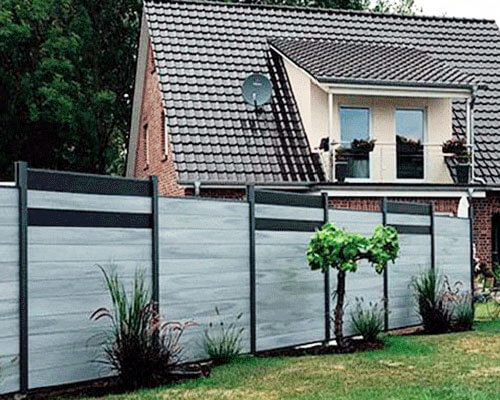
Composite fencing can provide privacy, visual consistency, and reduced repainting. Posts, aluminum reinforcement, wind loading, footing design, and panel expansion require careful planning.
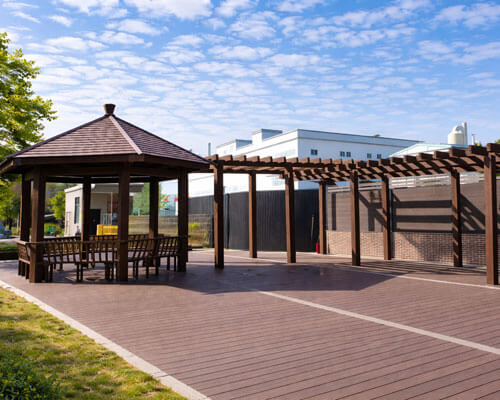
WPC profiles can form decorative beams, louvers, screens, and cladding around an engineered supporting frame. Confirm which components are structural and which are decorative.
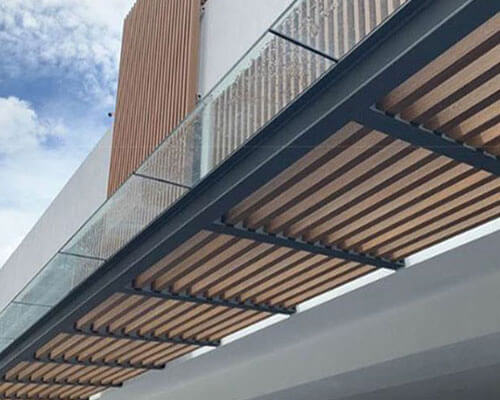
WPC louvers are used for privacy screens, façade details, and architectural shading. Attachment design should consider wind, profile length, support spacing, and thermal movement.
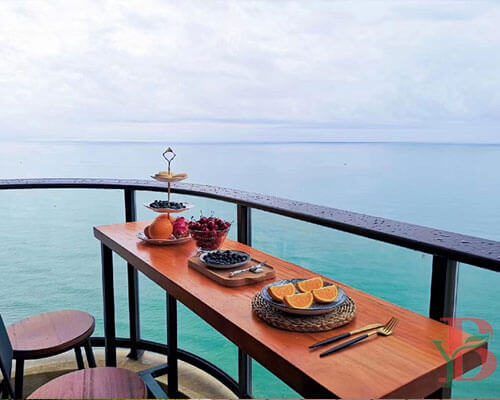
Outdoor Furniture and Landscape Products
Benches, planters, bins, tables, and landscape profiles can benefit from a consistent appearance and reduced coating requirements.
IS WPC Waterproof?
WPC is generally water-resistant rather than universally waterproof. The plastic matrix reduces direct water exposure compared with untreated wood, but the final water absorption depends on the formulation, density, fiber encapsulation, cap layer, cut ends, board geometry, damage, and installation.
Capped WPC normally provides stronger surface protection because the composite core is covered by a polymer shield. However, water must still be able to drain away. Standing water, blocked gaps, dirt, leaves, and poor ventilation can create staining or mold on organic debris even when the board itself has good moisture resistance.
For swimming pools, docks, coastal sites, and highly humid regions, ask for product-specific water absorption, slip-resistance, weathering, and installation data.
You can also review our guide to Capped Vs. Uncapped Composite Decking: Which is better?
How Long Does WPC Material Last?
There is no responsible single lifespan figure for every WPC product. Service life varies with material formulation, cap construction, UV exposure, climate, board color, drainage, installation, cleaning, traffic, impact damage, and maintenance.
Factors That Can Extend Service Life
- Suitable product for the climate and application
- Correct joist spacing and substructure
- Proper end gaps and side gaps
- Good ventilation and drainage
- Approved clips, screws, and accessories
- Routine removal of dirt and organic debris
Factors That Can Reduce Service Life
- Excessive unsupported span
- Poorly drained or enclosed substructure
- Incorrect fasteners or over-tightening
- No allowance for thermal movement
- Harsh cleaning chemicals or surface damage
- Using decorative profiles as structural members
Future Outlook: WPC Market Trends
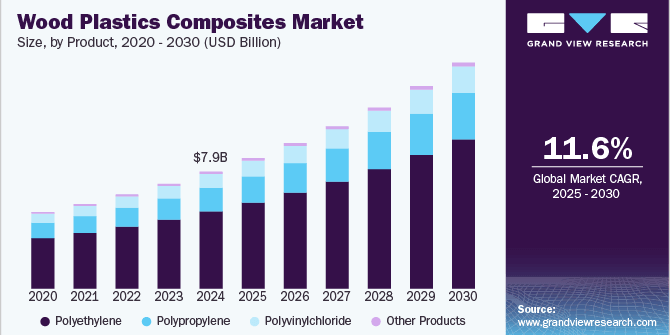
The future of WPC material is closely connected to demand for lower-maintenance outdoor products, renovation activity, recycled raw materials, and more consistent building-product performance. Although market-research firms use different methods and produce different forecasts, the overall WPC market outlook remains positive across decking, wall cladding, fencing, landscaping, automotive components, and other wood plastic composite applications.
2026 market snapshot: Grand View Research estimated the global wood plastic composites market at USD 8.89 billion in 2025 and projects it to reach USD 21.51 billion by 2033, representing an estimated CAGR of 11.7% from 2026 to 2033. Forecasts should be treated as directional rather than guaranteed because definitions, geographic coverage, and product categories vary between reports.
For a more detailed regional and application breakdown, see our internal report: Global Wood Plastic Composite Market Forecast 2025–2030.
Frequently Asked Questions About WPC Material
Is WPC better than natural wood?
WPC is often better for projects prioritizing lower routine maintenance, consistent appearance, and moisture resistance. Natural wood may be better when authentic grain, easy refinishing, established structural grades, or a completely natural material is the main priority.
Does WPC rot?
Quality WPC is more resistant to rot than untreated wood because the polymer helps protect the fiber. It is not immune to every form of deterioration. Poor drainage, exposed fiber, dirt accumulation, unsuitable installation, and low-quality formulation can still cause problems.
Does WPC fade in sunlight?
Some color change can occur, especially during early outdoor exposure or with uncapped products. Long-term fading depends on pigment quality, UV stabilizers, cap-layer technology, color, climate, and exposure. Ask for product-specific weathering data and warranty terms.
Is WPC maintenance-free?
No outdoor building material is completely maintenance-free. WPC is low maintenance compared with many timber products, but it still needs periodic sweeping, washing, drainage checks, and prompt removal of spills and organic debris.
Can WPC be painted or stained?
Some uncapped WPC surfaces may accept compatible coatings, but many products are designed to retain their factory color. Capped boards generally should not be sanded or coated because doing so can damage the protective surface and may affect the warranty.
Is WPC fireproof?
No. WPC products contain combustible components and should not be described as fireproof. Fire behavior varies by formulation, geometry, mounting, test method, and product classification. Confirm the applicable fire report for the destination market and application.
What is the future of WPC material?
The future outlook for WPC material is positive as demand grows for low-maintenance outdoor products, capped composite surfaces, realistic wood designs, recycled-content solutions, and better-documented performance. Future growth will also depend on raw-material consistency, climate-specific product design, testing, compliance, installation support, and credible sustainability claims.
Need WPC Samples, Specifications, or Factory Pricing?
Tell Bongywood about your target market, application, climate, profile, color, quantity, and required test standards. Our team can help you compare uncapped, capped, decking, cladding, fencing, and other WPC options.
Request Technical Information and a Quote